V7: The Nested Chronometric Architecture
The Temporal Decoupling framework proposes that time is not singular. Reality is structured in four overlapping chronometric layers (A-B-C-D), each with distinct mechanical properties. These layers did not end—they continue to exist right now, nested within one another.
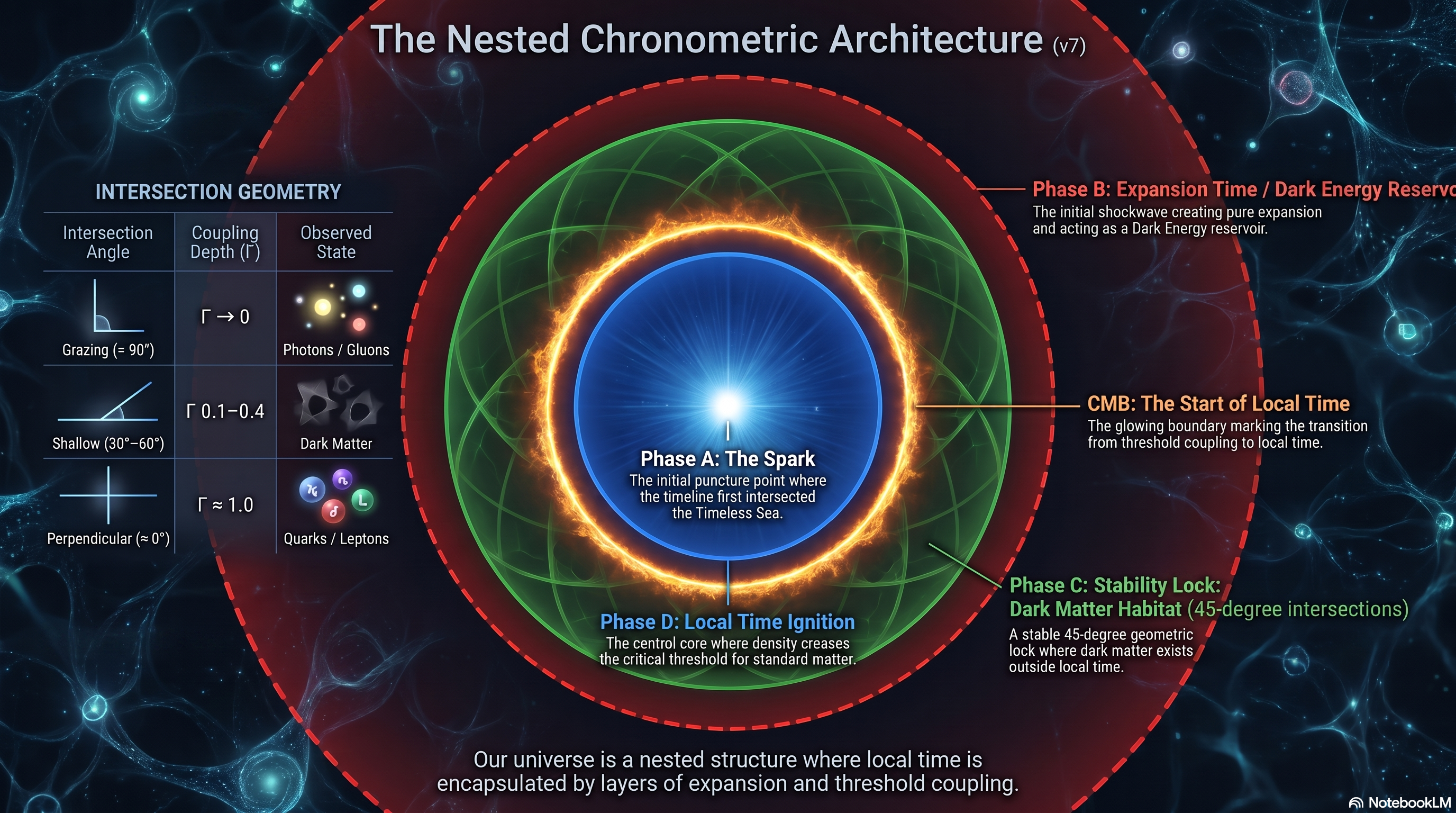
Simplified Timeline View
The Four Phases
Phase A: The Spark (Initial Puncture)
The timeline hypersurface (Σ) first intersects the static Timeless Sea (TSC). This topological instability nucleates the sweep that we perceive as the Big Bang. Phase A is an event, not a duration.
Phase B: The Void (Expansion Time)
The initial shockwave creates pure spatial expansion. Crucially, Phase B does not end—it is the enclosing environment for all subsequent evolution. It represents the raw, unhindered expansion of the substrate boundary.
Phase C: The Fringe (Threshold Time)
Inside the Void, a slow frame-rate layer forms. Particles in this layer experience shallow coupling to the timeline sweep. This is the domain of Dark Matter: particles geometrically locked at 45° symmetry, possessing mass (hydrodynamic resistance) but zero electric charge (symmetric vortices cancel).
Phase D: The Ignition (Local Time)
Where matter density crosses a critical threshold inside Phase C, Local Time ignites. This is the CMB epoch (~380,000 years post-Spark). Phase D is the fast frame-rate layer where we live—where electromagnetic interactions, chemistry, and consciousness emerge.
Key Mechanical Insights
- Dark Matter Location: Not a new particle type, but normal particles trapped in Phase C, outside the Local Time boundary.
- Dark Energy Resolution: As the universe expands and matter thins, Local Time uncouples at the edges. The raw Phase B expansion dominates—no new force required.
- Hubble Tension: The 9% discrepancy between local and CMB expansion rates directly measures the time-dilation ratio between dense (Phase D) and sparse (Phase B/C) regions.
Note: This Phase 1 framework unifies mass, charge, antimatter, and entanglement through geometric intersection parameters. Gauge bosons, color charge, and weak-force topology are reserved for Phase 2 development.