V7: Hydrodynamic Intersection Topology
The Standard Model's "particle zoo" is an illusion of perspective. What we perceive as a specific particle is simply the result of the geometric angle and depth at which our sweeping timeline intersects a static TSC entity.
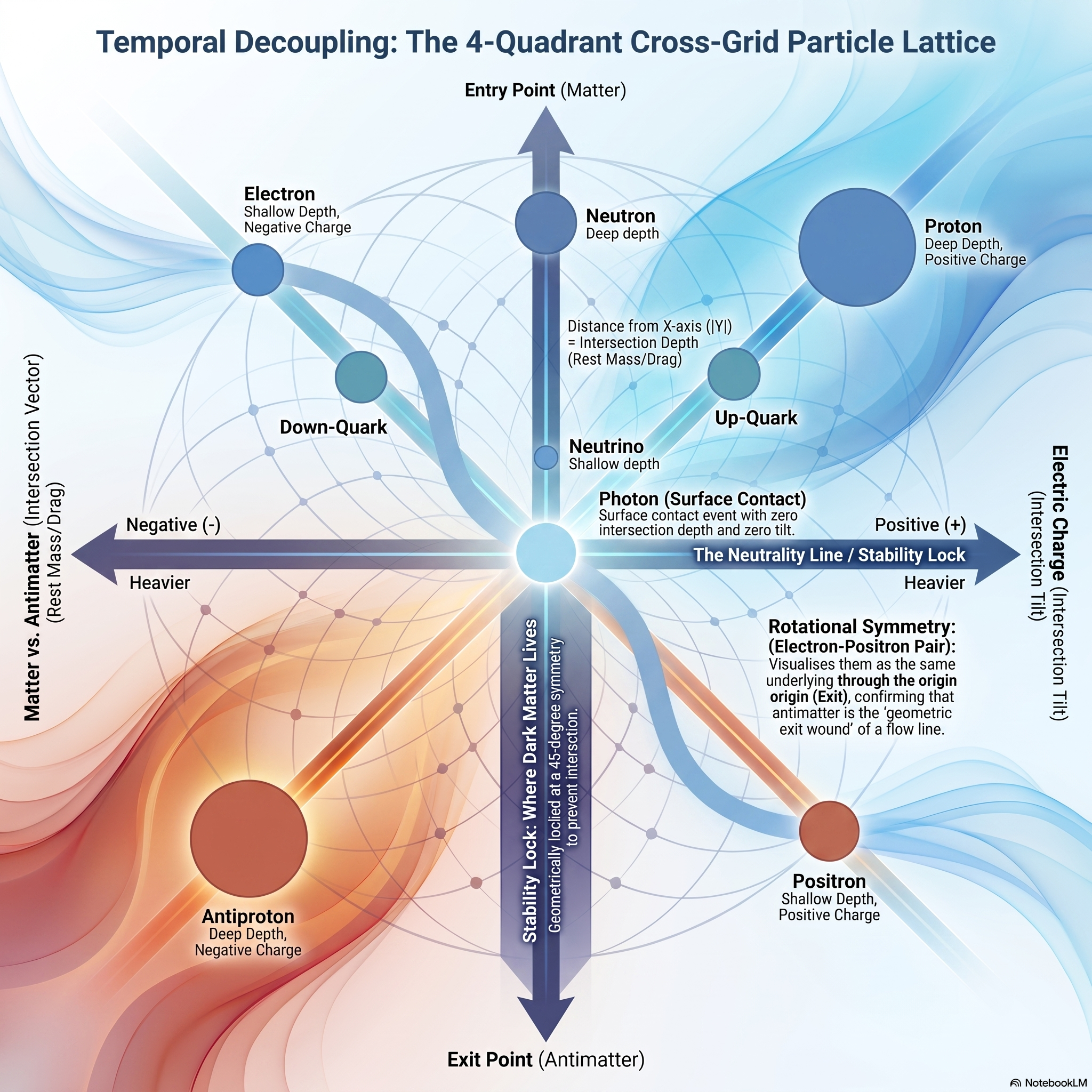
The Two Independent Dials
Dial 1: Intersection Depth → Rest Mass (Hydrodynamic Resistance)
Visualize the timeline as a flowing river. A TSC flow line is a stick dropped into the water.
- Grazing Depth (0°): Flat on water. Zero resistance → Photon
- Shallow Depth (~80°): Barely submerged. Minimal drag → Electron
- Steep Depth (0° perpendicular): Jammed into riverbed. Maximum resistance → Proton
Dial 2: Intersection Tilt → Electric Charge (Asymmetric Vortices)
Charge is not an intrinsic property—it is the directional dominance of fluid vortices created by asymmetric tilt.
- Perfect Symmetry (45°): Water hits left/right equally. Vortices cancel → Neutral (Neutron, Dark Matter)
- Asymmetric Tilt (Left): Dominant vortex pulls → Negative Charge (Electron)
- Asymmetric Tilt (Right): Dominant vortex pushes → Positive Charge (Proton)
Matter-Antimatter Symmetry
A flow line piercing the timeline creates an Entry Point and an Exit Point. The depth is identical (identical mass), but the left/right tilt is perfectly mirrored. If the Entry is Negative, the Exit is mathematically forced to be Positive. Antimatter is the topological conjugate—the geometric "exit wound"—of the exact same flow line.
The 45° Stability Lock: Why Dark Matter is Hidden
The 45° symmetric intersection is not merely a midpoint—it is a geometric stability lock. Particles residing in the Threshold Time layer (Phase C) that maintain perfect 45° symmetry:
- Have mass (hydrodynamic resistance from intersection depth)
- Have zero electric charge (symmetric vortices cancel)
- Do not couple to electromagnetic, strong, or weak forces
- Remain completely decoupled from Local Time interactions
Any deviation from 45° symmetry would trigger a topological change, converting the particle from invisible background mass into an active, interacting particle. Dark matter is not "missing"—it is geometrically locked in the only configuration that prevents interaction.
Chronometric Resolution: Why the Particle Zoo is Discrete
If angles are continuous, why no continuous particle spectrum? Local Time acts as a shutter speed. In low-density regions, the frame rate is slow. The timeline blurs out microscopic angle variations, snapping them to broad, stable states. The particle zoo is discrete because time has a finite resolution.
Open Challenge: We propose that mapping known particles onto a spherical topology—where Longitude represents sequential decay chains and Latitude represents coupling depth—will reveal an underlying geometric lattice. Empty nodes would predict undiscovered particles.