Gravity: Bulge vs. Well
General relativity models gravity as a geometric depression in spacetime—a 'well.' This framework proposes an alternative mechanical ontology with identical weak-field mathematics.
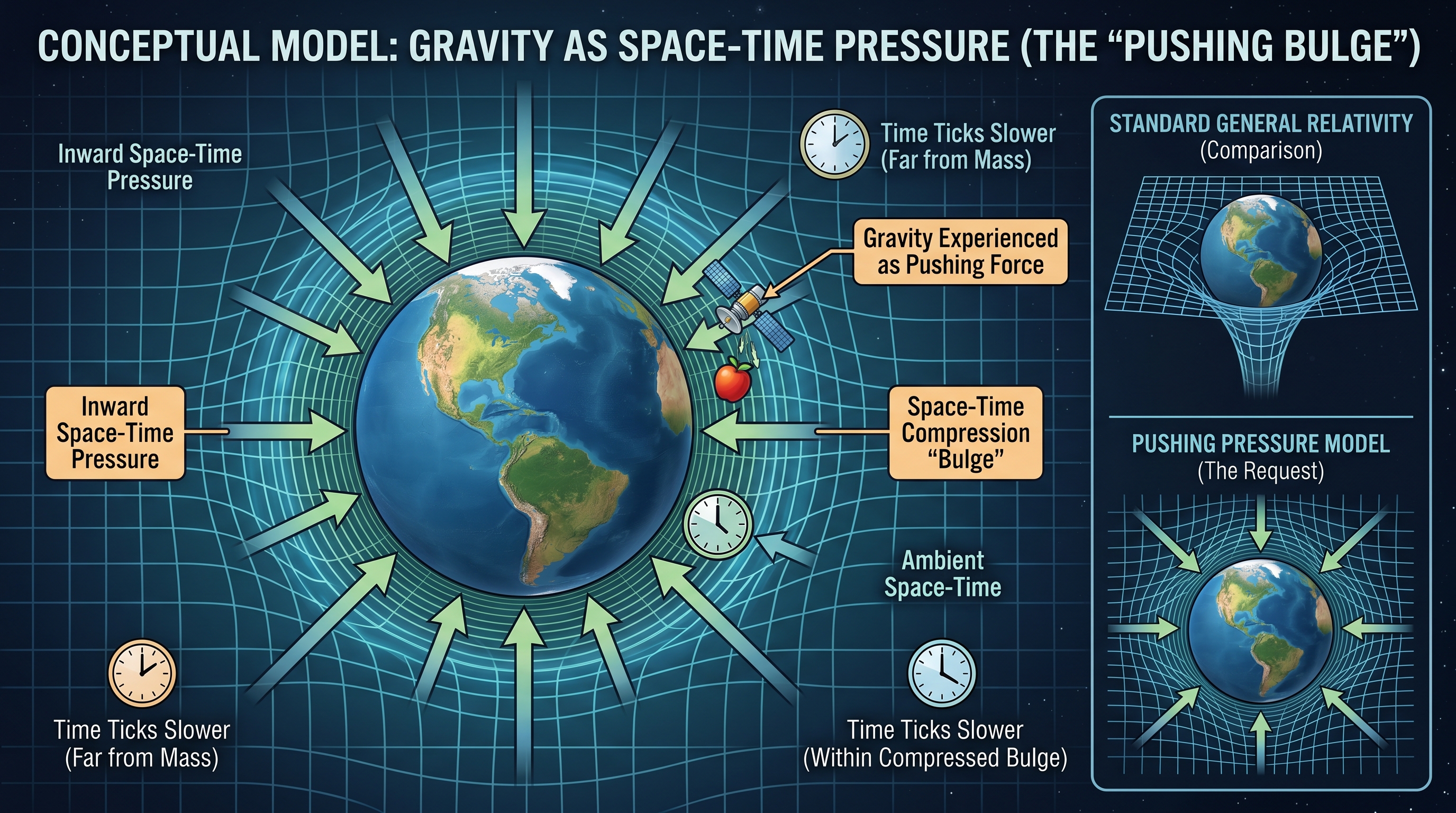
Inverted Causality, Identical Mathematics
Matter creates an outward pressure bulge into the static Timeless Sea (TSC). Objects are not pulled inward by a well; they are pushed inward by the surrounding TSC pressure differential.
Because this pressure gradient naturally recovers the standard Poisson equation ($\nabla^2\Phi = 4\pi G\rho$), this framework does not seek to replace general relativity, but to provide the underlying causal medium that produces it.
The Hydrodynamic Origin
When the timeline intersects a TSC entity, it creates hydrodynamic resistance. Dense accumulations of these intersections (planets, stars, galaxies) push outward against the static scalar medium. The surrounding TSC acts like a fluid trying to restore equilibrium. This inward-directed pressure is what we experience as gravitational attraction.