The L2 Falsification Test
A conceptual framework that cannot be broken is not science. The Temporal Decoupling framework makes a specific, strictly falsifiable prediction regarding quantum decoherence and gravitational density.
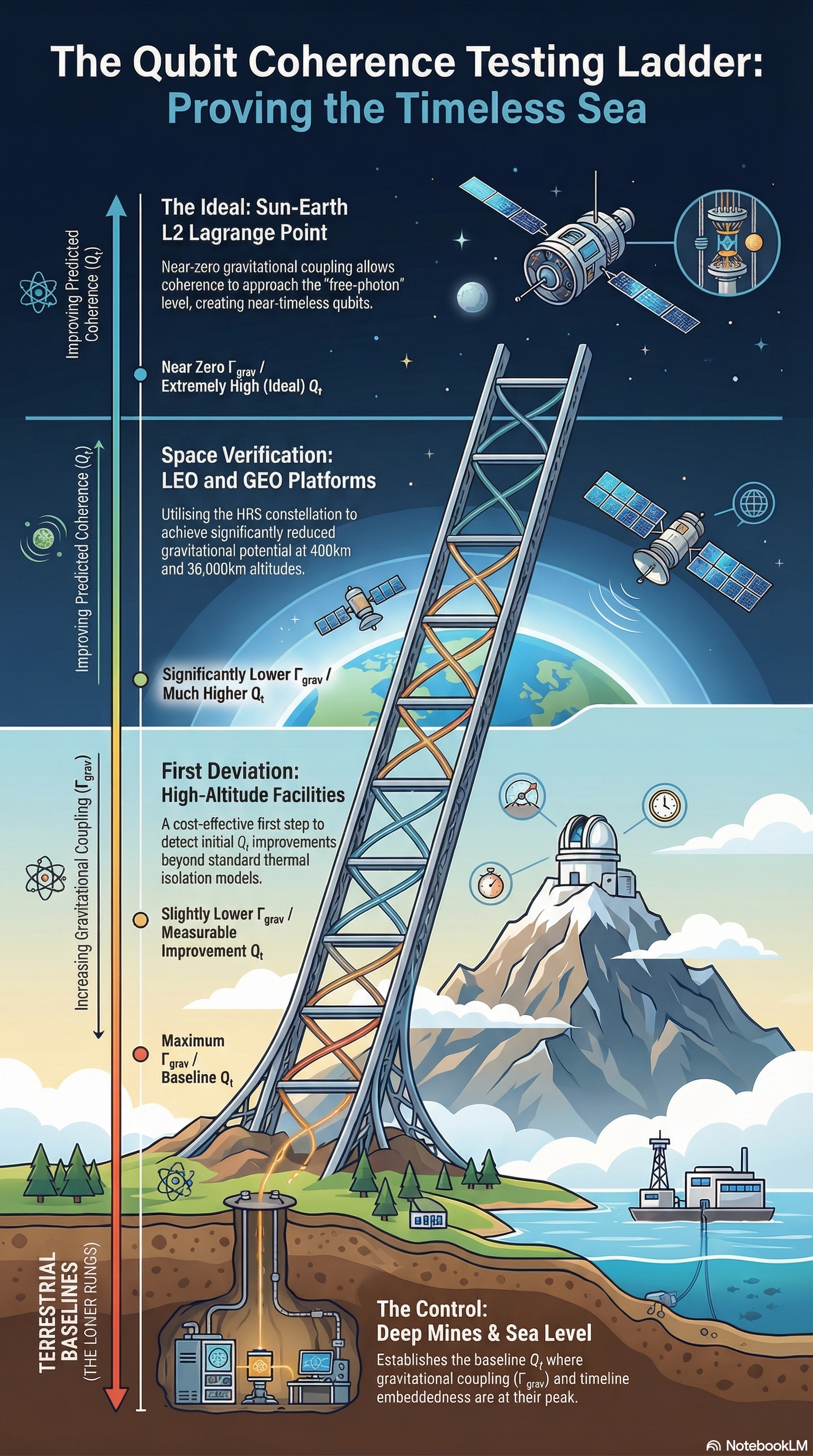
Primary Prediction: Qubit Coherence Scaling at L2
Standard open quantum systems models lack a fundamental environmental channel: Timeline Decoherence. This framework proposes that the total decoherence rate is the sum of standard thermal/electromagnetic noise and a timeline coupling rate (Γtimeline) that scales linearly with local gravitational density (ρ).
At the Sun-Earth L2 Lagrange point, the local gravitational potential is reduced by roughly two orders of magnitude (∼1/240 of Earth's surface). Removing this timeline friction should cause a proportional increase in coherence time.
The Prediction
Qubit coherence times (T₂) at L2 will exhibit an unexplained improvement in the range of one to two orders of magnitude (10¹ to 10²) beyond standard thermal isolation baselines.
Falsification Threshold
If T₂ scaling across superconducting, trapped-ion, and NV-center platforms at L2 perfectly matches standard environmental noise models with no anomalous gravitational/decoherence correlation, the timeline-coupling hypothesis is falsified.
Secondary Ground-Based Test: Dark Matter Chronometric Drift
If Dark Matter alters local density (ρ), it must alter local ticking time. The framework predicts that high-precision atomic clock networks will exhibit tiny, unexplained temporal drifts that correlate spatially with dark matter density maps.
Epistemic Boundary
This framework was not reverse-engineered to solve cosmological anomalies. It is a strictly constrained geometric architecture. We present the L2 prediction as the definitive experimental boundary: measure the decoherence, and let the timeline decide.