Hydrodynamic Particle Topology
The Standard Model particle zoo is an illusion of perspective. What we perceive as a specific particle is simply the result of the specific geometric angle and depth at which our sweeping timeline intersects a static TSC entity.
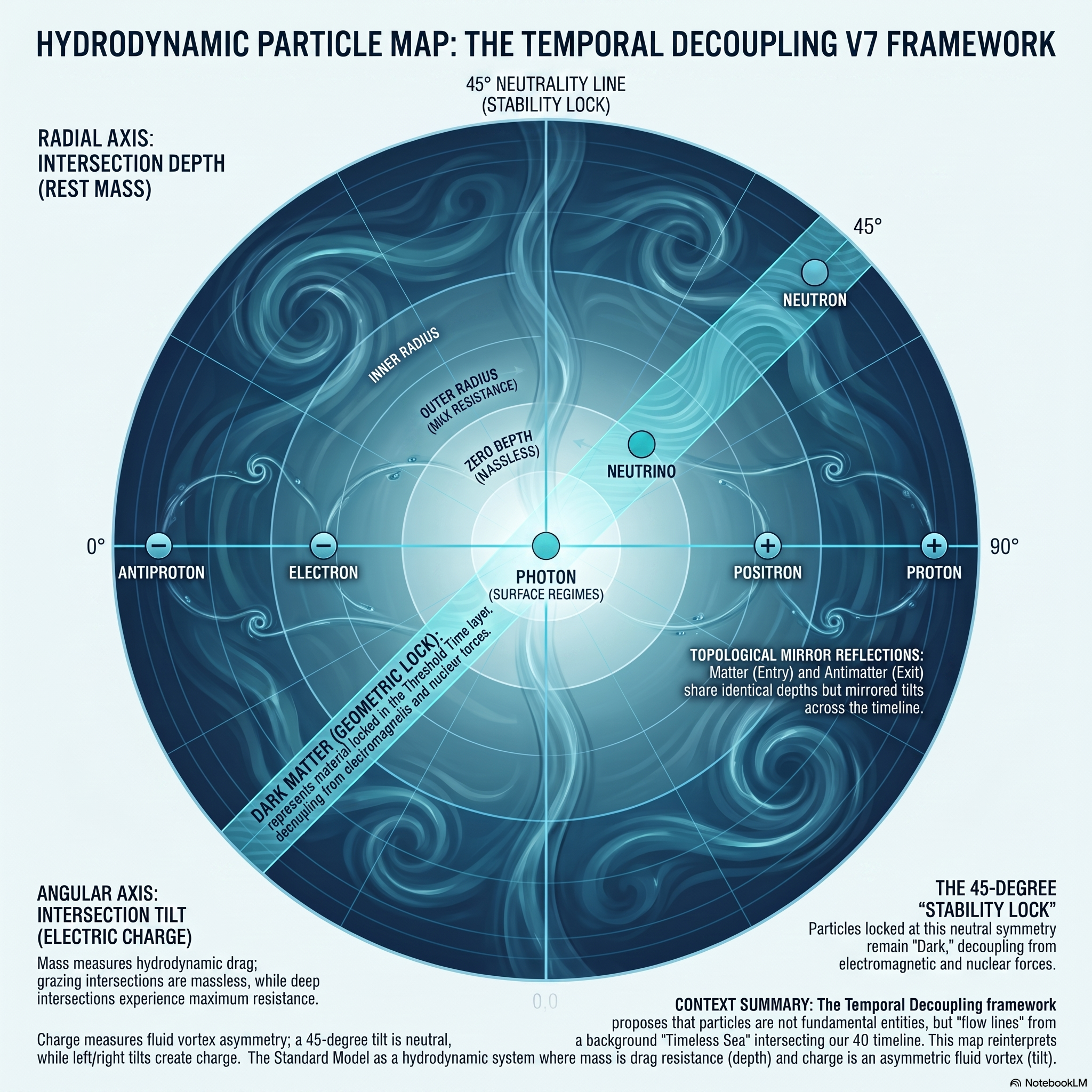
The River and the Stick Analogy
Visualize the timeline as a flowing river. A TSC flow line acts like a straight stick dropped into this moving water. Particle properties are controlled by two independent geometric dials:
Dial 1: Intersection Depth (Rest Mass)
Mass is a measure of hydrodynamic resistance against the timeline sweep.
- Grazing Depth (0°): Flat on water. Zero resistance → Photons.
- Shallow Depth (80°): Barely submerged. Minimal drag → Electrons.
- Steep Depth (0° Perpendicular): Jammed into the riverbed. Maximum resistance → Protons.
Dial 2: Intersection Tilt (Electric Charge)
Charge is a measure of asymmetric fluid vortices.
- Perfect Symmetry (45°): Water hits left and right equally. Vortices cancel → Neutral (Neutrons).
- Asymmetric Tilt: Water strikes one side harder. A dominant vortex forms. Push = Positive. Pull = Negative.
The 45-Degree Lock
The 45-degree symmetric intersection is a geometric stability lock. Any deviation from this angle triggers a topological change that converts the particle from invisible background mass into active, interacting matter.